
Altitude Journal
The Journal
Deep dives into the science and culture of consciousness.

One Dose, Years of Relief? What Psilocybin Trials Found in People With Cancer
Before psilocybin was tested for everyday depression, researchers tested it on people with life-threatening cancer. The results from Johns Hopkins, NYU and a community cancer practice in Maryland are some of the most durable in the field. Here's what each trial found, the caveats that come with them, and why a patient in Canada can get it legally while one in the U.S. mostly can't.

How Long Does Relief Last? Antidepressants vs. Psychedelics, by the Numbers
A new Lancet Psychiatry analysis of 115 trials found Lexapro, Cymbalta and agomelatine do best at keeping depression away over months of daily use. Psychedelic drugs promise something different, lasting relief from one or two doses. We put the durability data side by side.

The Day After Approval: Which States Will Let Doctors Prescribe Psilocybin
FDA approval of psilocybin won't make it legal everywhere overnight. Here's how the federal scheduling step works, which states have "trigger laws" that switch on automatically, which will need new legislation in 2027, and why "crystalline polymorph" could matter now that Usona has filed.

After the Election, the Fights Move Indoors: ICER, a Courtroom and a New Drug Law for Psilocybin
A week after the midterms, the next phase of the psilocybin race is playing out somewhere quieter. ICER has opened a cost-effectiveness review of Compass's drug, a trade-secrets suit against Compass is headed for trial, the FDA has answered the House psychedelics caucus, and a retiring congressman wants to rewrite the Controlled Substances Act.

What the 2026 Midterms Mean for Psychedelics: Who Won, Who Lost, and Which Compounds Feel It
A race-by-race look at the 2026 midterm results that touch psychedelics — the Senate and House flips, the FDA's new overseers, the Texas ibogaine program's changed leadership, new governors in New Mexico, Colorado and California, and the two ballot measures that actually mentioned drugs.
A Reader's Account: What Mantra Dose Euphoria Did to My Brain and Body
A reader wrote in after trying Mantra Dose Euphoria recreationally, on a friend's recommendation, following an earlier controlled psilocybin session they'd done for anxiety and depression. We're publishing their account alongside what the clinical research actually shows about psilocybin's effects — and what's unverifiable about this specific product.

Altitude People Series, Week 2 — Politicians: The Lawmakers Who Tried Ibogaine, and Why
Kyrsten Sinema and Morgan Luttrell are the two sitting or former members of Congress who've gone on record about personally trying ibogaine — not as recreational use, but as a specific response to a family history of dementia and a traumatic brain injury, respectively. Here's what they said, to whom, and the policy fights they're now leading because of it.
Everyone Knows Which Pill They Got. The FDA Just Said What To Do About It.
Functional unblinding is the methodological problem at the centre of psychedelic research. The FDA's final trial guidance says how sponsors must handle it — updated with a new systematic review and a more aggressive multidrug blinding proposal from UCSF, Stanford, and UC San Diego.

What a "Bad Trip" Actually Is — and What to Do If You're Having One
A bad trip is real, it's more common than the clinical trials suggest, and most people who have one say afterward it was still worth it. Here's what the research says, the warning signs that mean something more serious is happening, and a free peer-support line you can call tonight.

Altitude People Series, Week 1 — Sports: The Athletes Who Went Public About Psychedelics, and Why
From Aaron Rodgers' ayahuasca retreat in Costa Rica to the small, loosely connected network of former NFL players using ibogaine to treat what they believe is CTE, here's the documented record of athletes who've spoken publicly about psychedelics — on the record, with named journalists, and linked to the compound coverage behind each story.

MK-Ultra, Explained: What the CIA Actually Did With "Brainwashing Drugs" — and Why Congress Is Still Asking About It
The CIA spent two decades secretly testing LSD and other drugs on people who hadn't consented, looking for a way to control minds. It never found one. Here's what the declassified record actually shows — including why Congress held a hearing on it in June 2026.

EMDR: The Therapy Sandra Bullock Calls 'The Most Healing' — and Prince Harry Did on Camera
Search interest in EMDR is up roughly 22% in a year, and celebrities from Sandra Bullock to Prince Harry have spoken publicly about using it. We looked at what 26 clinical trials and several recent meta-analyses actually found — and why a handful of clinicians think pairing it with psychedelics could be the next real development.

Bicycle Day, Explained: The Three Days in 1943 That Accidentally Invented LSD
Every April 19th, psychedelic communities mark "Bicycle Day" — the anniversary of Albert Hofmann's first intentional LSD trip. But the story most people repeat is the one Hofmann told 36 years later in his memoir. The report he actually filed three days after it happened tells a rougher, less poetic version.

Is DMT Legal in Europe? Here's the Real Answer, Country by Country
No European country has legalized DMT. But "illegal" hides a messier reality — a UK Class A charge that can mean life imprisonment, a Czech fine of about $650 for personal possession, and two ayahuasca churches that briefly won religious-freedom protection in court before losing it.

Meet the 7 People Who Actually Lobby for Psychedelics in Washington
Seven named lobbyists work the psychedelics industry's federal accounts at Conafay Group and KPM Group DC. We pulled their actual career histories — one is a textbook revolving-door case, verified job by job; two others may have moved from an outside lobbying firm straight into the companies they used to lobby for.

Only 3 of 10 Psychedelic Companies Lobby Washington. One Just Joined — Twice, in the Same Quarter.
Federal LD-2 filings show only 3 of the 10 public psychedelic companies in our money rankings have ever registered to lobby Washington. One of them, Compass Pathways, didn't show up until 2025 — and when it did, it filed two registrations at once, spending $140K in a single quarter.

150+ Patents, $113 Million Raised, 4 Employees: Inside the Company Betting It Doesn't Need to Run Its Own Trials
Terran Biosciences holds the only granted patent on a new form of MDMA, was first to patent new salts of psilocybin, and has licensing deals with Sanofi and Pierre Fabre — all reportedly with a team of four. We looked at how a company this small built a pipeline this large, and what it's actually betting on.

16 States, 7 New Laws, 11 Dead Bills, Only 2 Still Alive: We Scored the 2026 Psychedelic Legislative Session
We tracked psychedelic-related legislation in 16 states through the entire 2026 session — direct from each state legislature's own records, not secondary aggregators. Seven bills became law, eleven died without a floor vote, and only two states still have anything technically alive.
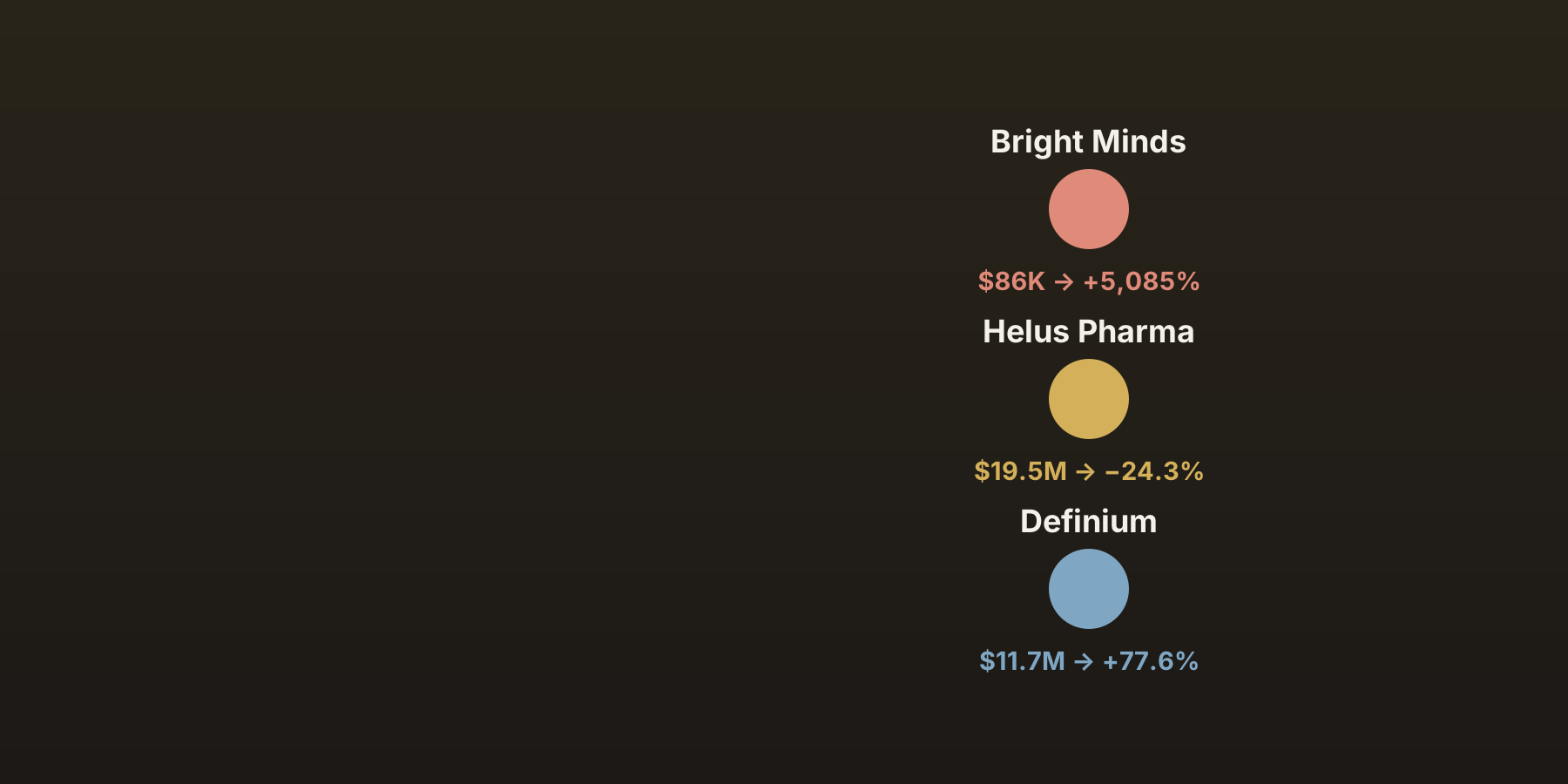
Which Psychedelic-Company CEO's Pay Actually Matched Their Stock's Performance? We Checked All 10 — Almost None Did.
We pulled three years of CEO cash and equity comp for all 10 public psychedelic companies straight from SEC proxy statements, SEDAR+ circulars, and ASX filings, then checked it against how each stock actually performed. The scatter plot shows almost no correlation at all.

How Clinical Trials Actually Work — and What It Means for the Psychedelic Industry
What does "Phase 3" actually require — how many patients, what counts as a win, who pays for it? We broke down how FDA trials really work, why psychedelics need a different rulebook than a normal pill trial, and where 5-MeO-DMT, psilocybin, LSD, and ibogaine each stand right now.

The "Nibble It" Problem: What Your Doctor Doesn't Have to Tell You About Off-Label Prescriptions
About half of all US prescriptions are written off-label — for a use, population, or dose the drug was never formally studied for. There's no FDA requirement that your doctor tell you that. We looked at three of the most commonly off-label-prescribed psychiatric drugs and what the side-effect data actually shows at the doses people are actually taking.
Nausea for 12 Hours vs. Sexual Dysfunction for Years: The Side-Effect Math Nobody's Doing on Mental Health Drugs
A single dose of a psychedelic causes nausea and headache that resolve within a day. A daily SSRI or Wellbutrin can cause sexual dysfunction in up to half of patients for as long as they're on it — and one of the biggest names in the daily-pill business has a $757 million fraud settlement to show for how it got there.

19% of American Adults Have Anxiety. Every Drug Treating It Is a Decades-Old Generic — Here's Who Wins If DT120 Changes That
No pharmaceutical company currently makes meaningful revenue from a branded anxiety drug — every major one is a decades-old generic. We looked at what happens to that market if Definium's LSD candidate DT120 actually gets approved, who's positioned to win, and which pharma giants analysts think are already circling.

The Psychedelic Money Graveyard: Renames, Reverse Mergers, and the Companies That Didn't Make It
Part two of the funding series. Behind the rankings is a much messier story — a wave of renames, a wave of consolidation, and a genuine graveyard of companies that raised real money and still didn't survive.

The Psychedelic Money Rankings: $11 Billion Public, $1.6 Billion Private, $140 Million From Governments
We tracked every public company, private funding round, and government dollar we could verify in the psychedelic-therapeutics sector. Part one is the rankings. Part two, next Friday, is the trends, the mergers, and the graveyard.

Permafried
A lot of people land on this site searching one word, half-joking and half-scared. Here's the actual difference between the glow after a trip, the myth of a fried brain, and the rare real thing.

Ibogaine's Flagship Drug Hit a Cardiac Signal and a Lawsuit. A Different Drug Is Now Leading.
A company-by-company look at who holds ibogaine's 53 patents — and how the compound's original opioid-use-disorder program stalled over a cardiac safety signal and litigation, while a different drug, for a different disease, became the first ibogaine-class compound ever cleared for a US trial.

Ketamine Has More Patents Than Any Compound We Track. So Why Isn't Big Pharma More Interested?
Ketamine holds 71 granted patents in our tracker — more than psilocybin, more than MDMA, more than anything else. Almost all of them trace to one drug. Here's why the compound with the biggest head start isn't getting the psychedelic industry's gold-rush treatment.
Altitude Intelligence Brief: Who's Actually Making Money on Depression, Anxiety, and PTSD
The drugs most Americans take for depression, anxiety, and PTSD are decades-old generics that make pharma almost nothing. The real money is in five newer, still-patented drugs most patients have never heard of.

Psychedelics in Uniform: What the Military Did to Soldiers, and What the VA Is Now Asking of Veterans
The Army spent decades dosing enlisted men with psychedelics they weren't told they were taking. Eighty years later, the VA and Pentagon are running versions of the same experiment again — with consent forms, IRBs, and an executive order behind them.

LSD Has 14 Patents in Our Tracker. The Company Closest to Approval Owns One.
A company-by-company look at the smallest patent footprint of any compound on our tracker — and why Definium, the company furthest along in trials, barely shows up in it.
The 5-MeO-DMT Patent Race Has a Twist: The Clinical Leader Barely Owns Any of It
A company-by-company look at who holds 5-MeO-DMT''s 164 patents — and why the program with the strongest Phase 2b data in the field has almost none of them.
Psilocybin Has 223 Patents in Play. Here's Who Actually Holds Them.
A company-by-company look at who's patenting psilocybin, what they're actually claiming, and why one of the biggest names in the field has spent a year fighting to keep its patents alive.
677 Patents and One FDA Rejection: Mapping the Psychedelic Drug Pipeline
Our own count of who's filing patents on psilocybin, MDMA, LSD, ketamine, ibogaine, and 5-MeO-DMT — what they're claiming to treat, where they're based, and the one company that's already been told no by the FDA.
I Flushed My Antidepressants in Paradise. I Got Lucky.
A psychopharmacologist, a prescription that made my brain feel like it was short-circuiting, and a decision I made alone in a hotel bathroom. What I didn't know then about SSRIs — and what nobody told me — turns out to be a much bigger story than mine.

Quick Trip or Daily Practice: The Brain Doesn't Care How You Get There
Psilocybin's calling card on an MRI is a quieted default mode network and a burst of new neural connections. A growing body of research says meditation and the vagus nerve reach some of the same systems — on a different timeline. The evidence points to complementary paths, not competing ones.

Kambo: The Ceremony That Promises Purification and Delivers Peril
A critical look at the frog secretion ritual gaining traction in wellness circles — including the first suspected UK death linked to it — and the medical evidence that should give you serious pause.

I Thought I'd Walked Into a Retirement Community. What I Found Was a Masterclass in How the Brain Stays Young
A visit to my aunt's 55+ community in Florida looked, at first, suspiciously happy. What I found underneath it was a daily structure that lines up with decades of research on community, purpose, and brain health.

Eli Lilly Just Paid $3.8 Billion for the Same Molecule People Get From a Toad
Eli Lilly's acquisition of AtaiBeckley centers on a synthetic version of 5-MeO-DMT — the compound underground "Bufo" ceremonies harvest from a wild toad. What the deal signals for the toad, the field, and the science.

Holding Your Breath On Purpose
A family meditation habit nudged a curious question at the breakfast table: could slowed breathing and brief breath‑holds be doing a little of the same brain‑clearing and neuron‑strengthening work researchers are now testing?

Love Yourself Five Times: How Psilocybin Changed My Life
A panic attack in the ER, a friend named Maria, and the retreat that changed everything.

The Next Psilocybin Question Is Not Hype. It Is Evidence, Timing, and Review.
A regulatory-watch explainer on why the next phase of psilocybin medicine is about evidence, timing, and review rather than hype.

Fear Is Not a Character Flaw. It's Architecture.
And here's what I've learned about rewiring it — from the amygdala to meditation to psychedelics.

Three Paths to a Healthier Brain: Learning, Meditation, and Psychedelics
Why neuroscience says you need all three — and how to combine them safely.
Clinical vs. Consumer: Navigating the New Psilocybin Landscape
The same compound, very different experiences. Understanding the difference between clinical and consumer use is essential.

What Is Evidence-Based Healing? A Guide to Altitude Global's Standards
The healing and wellness space is experiencing a credibility crisis. Here's how Altitude evaluates practitioners.
The God Molecule and the Spilled Milk
How a single encounter with Bufo changed the way I move through the world.
The Clinical Revolution: Psilocybin and 5-MeO-DMT Move from Underground to Evidence-Based Medicine
Rigorous clinical trials are providing what decades of anecdotal evidence couldn't: peer-reviewed data showing these compounds may offer rapid, sustained relief.